

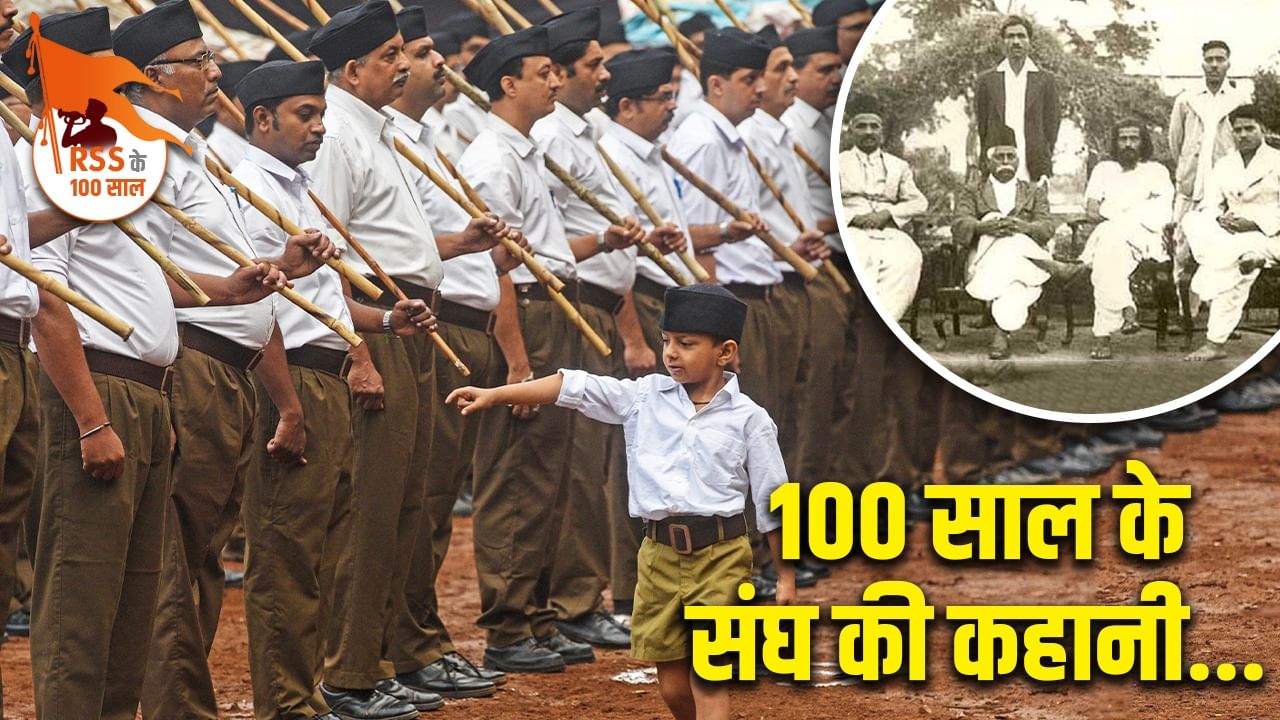
On September 27, 1925, in Mumbai, Dr. Keshav Baliram Hedgewar, with five volunteers, founded the Rashtriya Swayamsevak Sangh (RSS). Initially, this endeavor was met with skepticism; the organization, however, has since evolved into a significant voluntary and Hindu organization worldwide.
As the RSS approaches its centenary, it has a substantial presence across India, encompassing over 75,000 branches. The organization reports over 10 million trained members and includes more than 80 affiliated organizations. The RSS’s sphere of influence extends to approximately 40 countries, illustrating its global impact. Presently, there are more than 56,000 daily shakhas, supplemented by around 14,000 weekly and 9,000 monthly shakhas.
This article traces the establishment and evolution of the RSS.
### From the Khilafat Movement to the Birth of the RSS
The year 1919 saw the close of World War I and the disintegration of the Ottoman Empire. The British’s removal of the Caliph of Turkey, a figure revered by Muslims globally, sparked widespread resentment. In India, which was under British rule, Muslims began to protest.
This resulted in the Khilafat movement, led by the Ali brothers, aiming to reinstate the Caliph. The movement gathered considerable support.
The atmosphere in India was already tense due to the Jallianwala Bagh massacre and the Rowlatt Act. Mahatma Gandhi, who had just returned from South Africa, was organizing a mass movement. He believed the Khilafat movement could foster Hindu-Muslim unity.
### Hedgewar’s Contrasting Views with Gandhi
Hedgewar, a young Congressman, disagreed with Gandhi’s approach, deeming it risky to prioritize religious interests over national ones. Despite his reservations, he took part in the movement, later facing imprisonment for his impassioned speeches.
In 1921, when the movement reached Malabar, conflicts arose between Muslim farmers and Hindu landowners. Dr. B.R. Ambedkar criticized the violence, and Annie Besant questioned Gandhi’s actions.
Hedgewar was deeply affected by the events, which led him to recognize the necessity for a separate Hindu organization. Although he initially joined the Hindu Mahasabha, he became disillusioned, finding it too focused on political dealings, failing to protect Hindu interests genuinely.
### The RSS’s Foundation on Vijayadashami
On September 27, 1925, during Vijayadashami, Hedgewar and his associates founded the Sangh. This was the inception of the RSS.
Initially, members met twice a week, with exercises on Sundays and discussions on national matters on Thursdays. These meetings, called shakhas, became fundamental to the Sangh’s identity. The organization was formally named the Rashtriya Swayamsevak Sangh on April 17, 1926, with the first uniform being displayed on Ram Navami that year.
Regular shakhas began at Mohite’s Wada in Nagpur, which enabled the Sangh to expand its influence throughout Indian society and politics.
### Hedgewar’s Method for Expanding the RSS
Hedgewar encouraged students to establish shakhas in their colleges to propagate the Sangh’s principles. He would personally monitor the progress of these shakhas.
The first branch outside Maharashtra was launched in Varanasi in 1930. This branch was significant because it facilitated the association of the second Sarsanghchalak, Guruji (Madhav Sadashivrao Golwalkar), with the Sangh. Hedgewar personally engaged with those who did not regularly attend, fostering personal connections and encouraging more people to join, which allowed the Sangh to spread nationally.
### Leadership Transitions: Sarsanghchalaks Who Passed Away While in Office
From 1925 onwards, there have been six Sarsanghchalaks. Dr. Hedgewar, who founded the RSS, led from 1925 to 1940. Golwalkar succeeded him from 1940 to 1973. Madhukar Dattatreya Deoras, known as Balasaheb Deoras, became Sarsanghchalak in 1973. Rajendra Singh, also known as Rajju Bhaiya, assumed the role in 1993, and in 2000, due to health concerns, he transferred the position to Kripahalli Sitaramayya Sudarshan. Sudarshan then passed his responsibilities to Dr. Mohanrao Madhukarrao Bhagwat (Mohan Bhagwat) in 2009, also due to health issues.