

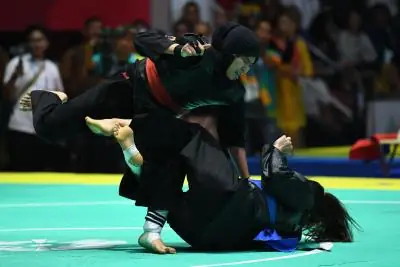
Indonesia’s Pencak Silat stands as a testament to human ingenuity in combat, where agility reigns supreme and self-defense is an art form. This martial discipline, practiced by over 10 million, weaves physical mastery with cultural reverence.
Historical scrolls trace its origins to the 6th century, forged in the fires of Srivijaya Empire skirmishes. Evolving through Dutch colonial resistance, it absorbed influences from Chinese kung fu and Indian silambam, creating a rich tapestry of techniques.
Core to Pencak Silat are the ‘langkah,’ footwork patterns that enable 360-degree mobility. Strikes target vital points with surgical accuracy—eyes, throat, groin—while sweeps and trips exploit gravity. Women train equally, adapting flowing motions for leverage over strength.
Mental training is paramount: ‘tenaga dalam’ builds inner energy through breath control, fostering unbreakable focus. Competitions divide into ‘artistic’ (poetry in motion) and ‘combat’ (no-holds-barred sparring), testing both.
In today’s volatile world, Pencak Silat academies boom in Europe and the US, attracting MMA fighters for its grappling edge. UNESCO’s 2019 inscription underscores its role in identity preservation. Whether safeguarding villages or personal safety, Pencak Silat empowers with elegant ferocity.