

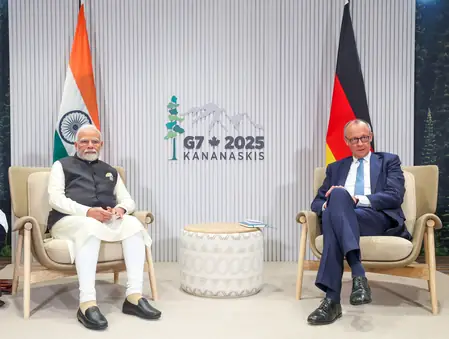
In a move that highlights evolving global alliances, German Chancellor Friedrich Merz begins his two-day India visit today. This landmark trip—his first to India and Asia in his current role—features summit-level discussions with Prime Minister Narendra Modi on Sunday, coupled with an appearance at the International Kite Festival.
The bedrock of India-Germany synergy includes shared values of democracy, thriving commerce and investments, defense pacts, climate and clean energy drives, frontier S&T partnerships, cultural dialogues, and burgeoning education links. Collectively, they influence Indo-Pacific dynamics and European trajectories.
Positioned as a cornerstone partner in Europe for India, Germany shares deep historical roots established March 7, 1951. Celebrations for 75 years of diplomacy are slated for 2026.
Elevating ties, the 2000 Partnership Agenda reached 25 years in 2025, marked by a logo reveal from Foreign Ministers S. Jaishankar and Annalena Baerbock in May.
Annual IGCs since 2011 facilitate comprehensive assessments and innovation scouting. New Delhi hosted the seventh in October 2024.
United by commitments to multilateral engagement and international norms, they align strategies in multilateral arenas and support G4 efforts for UNSC expansion—their recent ministerial huddle at the 80th UNGA in September 2025.
Leadership exchanges abound: PM Modi’s 2022 Berlin IGC and Munich G7 visits; Chancellor Scholz’s 2023 state visit and 2024 IGC return. Modi-Merz interactions started May 20, 2025, extending to G7 in Canada and G20 in Johannesburg.
India’s 300,000-strong community in Germany, including 60,000 students, excels in IT, banking, science, entrepreneurship, and nursing, fueling people-to-people bonds.
As Chancellor Merz engages, expectations run high for breakthroughs that fortify this vital partnership against global uncertainties.