
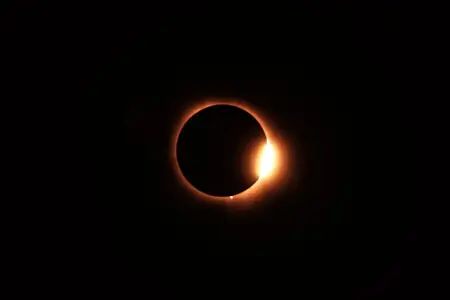
Astronomy enthusiasts note: 2026 opens with an annular solar eclipse on Dars Amavasya, Tuesday’s Falgun Amavasya. The moon won’t fully obscure the sun, instead crafting a glowing ‘ring of fire’ – but only for southern hemisphere observers. India lies in total darkness regarding this event; zero visibility nationwide.
Epicenters include Antarctica’s expanse, South Africa, Zimbabwe, Zambia, Tanzania, Mauritius, and South American pockets. IST schedule: starts 3:26 PM, climaxes 5:42 PM, wraps 7:57 PM. Aquarius placement with Dhanistha nakshatra adds layers for astrologers.
No sutak in India – eclipse invisibility nullifies the 12-hour pre-eclipse restriction per religious norms and Drik Panchang. February 17 remains fully open for rituals, auspicious works, daily life. Key panchang: Amavasya to 5:30 PM, Dhanistha to 9:16 PM (Shatabhisha follows), Capricorn moon.
Sunrise 6:58 AM, sunset 6:13 PM. Golden hours: Abhijit Muhurat 12:13-12:58 PM, Vijay 2:28-3:13 PM, Godhuli 6:10-6:36 PM, Amrit Kaal 10:39-12:17 PM. Red zones: Rahukaal 3:24-4:48 PM, Yamaganda 9:47-11:11 AM, Adal Yoga 9:16 AM-6:57 PM.
The eclipse’s crown jewel – that fiery ring – manifests over Antarctica and southern seas, with partial shadows sweeping South America, Africa south, Atlantic/Pacific south, and more Antarctic zones. Excluded: India, neighbors like Sri Lanka/Nepal, Asia broadly, Europe, North America bulk, Australia’s mainland, Africa’s mid/north. A polar spectacle for the ages.