
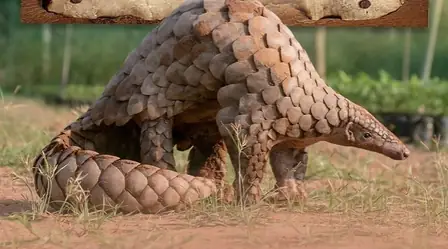
Across India’s varied terrains – verdant forests, rugged hills, open plains, and dry zones – dwells the elusive Indian pangolin, a peaceful enigma wrapped in natural armor. The world’s sole mammal boasting keratin scales, it sports 160-200 overlapping plates in mud-matching brown, earning nicknames like ‘pancake anteater’ for its distinctive form.
Size-wise, it’s compact: head-to-tail 84-122 cm, tail 33-47 cm, body mass 10-20 kg. Shy, slow, loner, and strictly nocturnal, it hunkers in burrows daylight hours, venturing out to hunt under cover of darkness. Ground-dweller supreme, it gravitates to insect-rich thickets, roots, and mounds.
Survival hinges on genius defenses and feeding prowess. Spot a threat? Curl into a scaly orb – impenetrable to predators like lions or leopards. Offensively, those mighty foreclaws shred termite hills. Then unleashes the tongue: a 40+ cm marvel, glued near pelvis and ribs, coated in adhesive saliva to lasso ants, termites (all life stages), beetles, cockroaches.
Beyond survival, it’s an environmental linchpin. Gulping hordes of insects curbs outbreaks harming farms and forests. Excavations oxygenate earth, boost hydrology. Peril looms large: IUCN endangered status, India’s Schedule I protection notwithstanding. Scales fuel illicit trade for mythical medicines, ornaments.
Hope springs from collaborations – conservation NGOs with state forestry in Madhya Pradesh, probing ecology, ranges, habitat patterns for targeted safeguards. Unraveling the pangolin’s mysteries underscores urgency: protect this quiet pest-controller, or lose a key to biodiversity forever.