
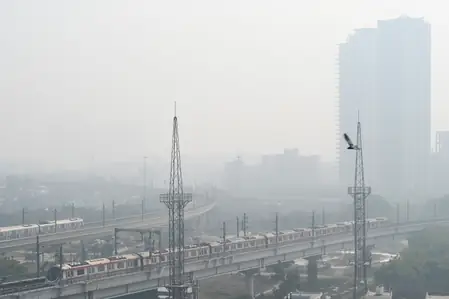
Delhi-NCR’s battle against air pollution intensifies as wind speeds plummet, confining pollutants and driving AQI into the severe red zone across key urban pockets. Noida, Delhi, and Ghaziabad report critically high readings, prompting renewed calls for emergency protocols.
Detailed station data from Delhi exposes the severity: Ashok Vihar tops with 337, Burari Crossing 345, Bawana 321, Anand Vihar 319, Chandni Chowk 302—all hazardous. Pockets like Alipur (242), DTU (271), Dwarka Sector-8 (234) linger in very poor orange, Ayanagar (158) and CRRI Mathura Road (189) in moderate yellow. Low wind velocity is the culprit, allowing fine particles to blanket the atmosphere.
Across the Yamuna in Noida, Sector-125 hits 286, Sector-62 223, Sector-1 234, Sector-116 232—predominantly orange with red tendencies. Ghaziabad suffers acutely: Indirapuram 324, Vasundhara 301 (red), Sanjay Nagar 251 (orange).
Meteorologists predict a turnaround on February 18 with morning rains, thunder, lightning, and 30-40 km/h winds, light showers possibly later. Today’s max-min: 30°C/13°C; tomorrow 27°C/14°C; February 19-21 steady at 27-28°C/13°C under mostly clear skies with haze.
This incoming western disturbance promises to ventilate the region, reducing pollutant concentration and AQI. In the interim, mask up, avoid peak traffic hours, and monitor updates. NCR’s air quality rollercoaster highlights the urgent need for long-term solutions beyond weather whims.