
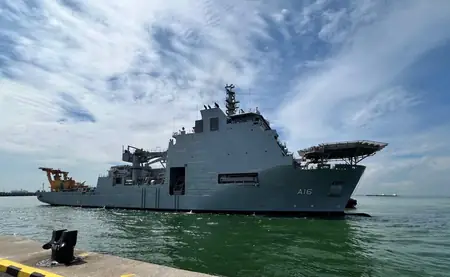
In a twist of naval poetry, Visakhapatnam—final resting place of Pakistan’s PNS Ghazi—will host India’s 2026 International Fleet Review (IFR). With Pakistan sidelined from participation, the symbolism is stark. The 1971 war saw Ghazi, tasked with destroying INS Vikrant, obliterated by INS Rajput. Diving ops by the original INS Nistar confirmed the kill.
Enter the new INS Nistar: a fully indigenous Diving Support Vessel commissioned in July 2025, primed for IFR duties right above the wreck. This isn’t coincidence; it’s a statement of supremacy. The navy now boasts two such vessels—Nistar and Nipun—crafted by Hindustan Shipyard since 2018, with minor COVID delays.
At 120 meters long and 10,000 tons heavy, Nistar zips at 18 knots, loaded with modern diving tech. Its 80% local build supports DSRVs for submarine rescues in dire straits: trapped crews, hull breaches, or total submersion. ‘Nistar’ signifies liberation, perfectly suiting its life-saving mission—a rarity even among superpowers.
India’s aircraft carrier INS Vikrant, reborn indigenously, also patrols these waters, mirroring the past. The IFR and Milgem drills will draw international attention, highlighting India’s blue-water ambitions. For Pakistan, it’s a fresh scar; for India, validation of strategic depth and technological leap. This convergence of history and horizon sets the stage for maritime dominance.