
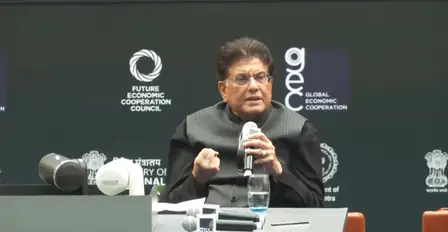
Union Commerce Minister Piyush Goyal set the stage ablaze at Mumbai’s GEC 2026 conference, forecasting a monumental $26 trillion addition to India’s economy by 2047. His keynote on the event’s second day painted a picture of unparalleled expansion, captivating an international audience.
Assembling ministers from key economies—France, UK, UAE, US, Australia, Seychelles, others—GEC 2026 addresses trade disruptions and multipolarity by designing future-proof economic blueprints. Goyal detailed India’s alliance-building spree: nine FTAs in four years, prioritizing national safeguards alongside growth avenues for industries and MSMEs.
Economic isolation is passé, Goyal proclaimed. FTAs signal partnership in India’s climb to global top-three by 2027-28 and $30-35 trillion maturity by 2047. ‘Join our trusted, open journey,’ he urged genuine collaborators.
Hosted by FECC with Maharashtra and MEA support, the forum boasts leadership from Chauthaiwale, Gandhi-Modi, and advisors like Mahindra, Kalyani, Shroff, Zainulbhai. With 16 FTAs operational, India deftly guards agri-interests while expanding in textiles, leather, pharma, and seafood exports.
Jaishankar highlighted de-risking trends; India’s playbook emphasizes self-reliance and deeper engagements toward Viksit Bharat 2047. Fadnavis called GEC a counter to trade volatility, where capital chases geopolitics over returns alone.
Kalyani touted India’s connector role, inviting co-development. The agenda spans resilience, infrastructure, corridors, supply diversification, tech shifts, sustainability, and women-led growth.
In this power-shifting landscape, GEC bolsters India’s stature as investment magnet and economic stabilizer.