
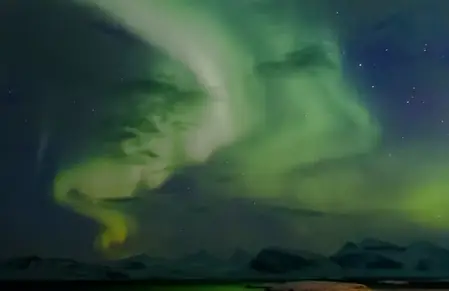
Few natural wonders rival the aurora’s symphony of colors rippling across polar skies. Green waves blend into purple curtains, reds flicker alongside blues— a live painting in the heavens. Scientifically termed auroras, these are borne from cosmic particle bombardments, offering a window into solar dynamics.
The process begins billions of kilometers away with solar wind: protons and electrons hurtling at 400-800 km/s. Earth’s magnetosphere deflects most, but funneling occurs at polar cusps, injecting particles into the ionosphere. There, excitation of neutral atoms releases photons upon de-excitation, birthing the glow.
Color coding reveals atmospheric chemistry. Predominant green traces atomic oxygen at 115 km; rare reds signal molecular oxygen above 200 km. Nitrogen’s contributions include violet (first negative system) and pink (at lower energies). Height, particle energy, and gas density dictate the palette, yielding ever-shifting patterns.
Solar proactivity dictates visibility. Flares and CMEs unleash plasma clouds, arriving after 1-3 days to ignite substorms. These expand auroral ovals, thrilling viewers in unexpected locales. Ground observatories wield photometers for emission lines, riometers for absorption, and GNSS for ionospheric scintillation.
Global networks like SuperDARN radars and THEMIS satellites synchronize data, modeling energy deposition. Auroras underscore our vulnerability to space weather, influencing aviation, GPS, and electrical systems. As we approach solar maximum, heightened activity promises prolific sightings, blending science with awe.