
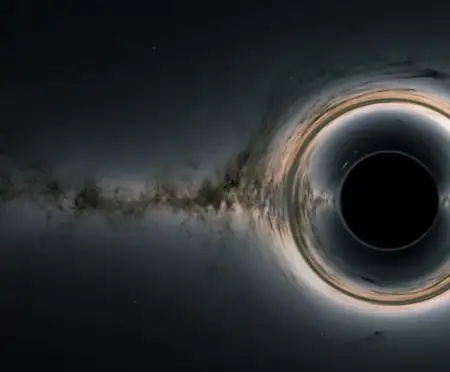
Picture a place in space so dense that its gravity devours light, time, and matter alike—that’s a black hole. These aren’t literal holes but gravitational behemoths formed when massive stars exhaust their fuel and implode, leaving behind spheres of pure intensity.
Encircling the darkness, the accretion disk churns with infalling debris, igniting into a furnace of X-rays and high-energy radiation. This fiery halo is how we ‘see’ the unseen, as direct observation remains impossible due to their light-trapping nature.
Enter gravitational lensing: black holes curve spacetime, redirecting light rays like a funhouse mirror. Stars and galaxies behind them appear warped, duplicated, or magnified, providing astronomers with tools to uncover stealthy black holes embedded in distant clusters.
The event horizon marks the doom line—no signals escape. Our galaxy’s Sagittarius A* exemplifies supermassive variants, 4 million times solar mass, lurking at the Milky Way’s heart. Get too near, and spaghettification awaits: unequal pull tears you into a noodle before the crush.
Sizes vary wildly—the tiniest known tips the scales at 3.8 solar masses, while TON 618 dwarfs all at 660 billion. Kerr black holes whirl frantically, some exceeding 1,000 RPM equivalents. Dispelling myths, they’re no wormholes or vacuums; their distant effects blend with stellar gravity. Ongoing missions like those from NASA peel back layers of these cosmic puzzles, reshaping our view of the universe.