
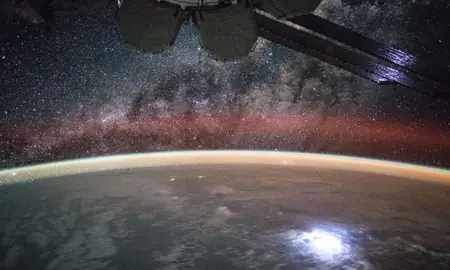
High above our world, the International Space Station reveals Earth’s secret nighttime beauty: airglow. This radiant veil of red, green, purple, and yellow bands encircles the planet, visible only from space or the darkest skies. Far from the iconic blue planet images, airglow unveils the upper atmosphere’s glowing response to solar stimulation, ensuring no true blackness in the cosmos.
NASA scientists describe airglow as luminescence from energized atmospheric particles. Sunlight’s extreme ultraviolet rays during daylight supercharge atoms like oxygen and nitrogen. At night, they shed excess energy as visible light, distinct from auroras which demand solar storm fury. Everyday solar photons suffice here, with occasional electron collisions amplifying the glow.
On Earth, this faint sheen persists post-light pollution removal, rivaling a tenth of starlight’s total. Orbiting views depict Earth as a luminous sphere, with airglow thriving 50-400 miles aloft in the ionosphere—home to vital GPS paths and astronaut transits.
Distinct colors fingerprint gases: vivid greens from oxygen emissions at optimal heights, reds from varied molecular dances, and imperceptible UV/IR contributions. Upper atmosphere’s rarity permits sustained glow before collisions dampen it, contrasting dense tropospheric quenching.
Dynamic and responsive, airglow morphs with solar flux and terrestrial winds, acting as a sentinel for ionospheric health. It discloses motion vectors, heat gradients, and density shifts, forging links between space weather volatility and ground-level forecasts.
Through persistent ISS observations, researchers harness airglow’s patterns to probe atmosphere-space interplay. This glowing archive not only enchants but equips us to navigate solar-induced hazards, from comms blackouts to orbital threats, in our expanding spacefaring era.