
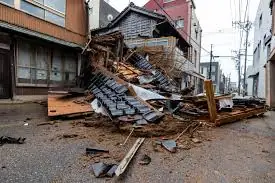
A robust 6.1 magnitude earthquake jolted Japan’s Volcano Islands at dawn Monday (03:55 GMT), as reported by the German Research Centre for Geosciences. Centered at a mere 10 km depth in the Pacific Ocean, the quake unfolded in one of the world’s premier subduction zones.
Lying within the Izu-Bonin-Mariana arc, this area witnesses the Pacific plate subducting under the Philippine Sea plate, birthing frequent moderate quakes from intra-plate faulting. Distances from land underscore its isolation: 937 km from Saipan, 957 km from Tinian, and 1,090 km from Guam—far enough to avert disaster.
No tsunami warning followed, a relief given the shallow focus. Echoing a prior January 21 event—also 6.1 magnitude but deeper at 25.5 km, per USGS and EMSC—this tremor fits the pattern of routine 6.0-6.5 activity that seldom inflicts serious harm.
Japan’s geology is a tectonic marvel and menace, featuring deep trenches, volcanic chains, and a four-arc setup fueling 80% of its earthquakes. Subduction forces dominate, turning the nation into a living seismology lab.
Though the Volcano Islands’ sparse habitation spared lives, the quake reverberated regionally, prompting checks in nearby territories. Japan’s storied earthquake preparedness—evident in drills, tech, and building codes—shines through once more.
Experts anticipate monitoring for aftershocks, but history suggests minimal fallout. This episode reinforces the imperative of global seismic readiness in subduction hotspots, where Earth’s plates forever clash.