
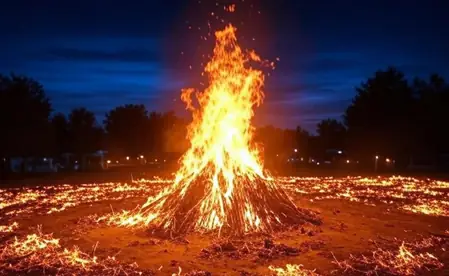
Holi’s dual essence—Holika dahan’s purifying fire followed by playful colors—unites millions, yet Barsai in Saharanpur defies the norm. Here, the village skips the bonfire entirely, channeling its energy into a colorful extravaganza, all due to a profound mythological connection.
Central to Barsai is its west-facing Shiva temple, housing a Svayambhu lingam untouched by human hands. Ancient tales claim Kauravas erected it before the Mahabharata, but Bhima’s mighty intervention—thrusting his mace to swivel the entrance westward—created India’s sole such shrine.
Devotees believe igniting Holika within village limits risks singeing the deity’s feet, positioned vulnerably toward the fire’s direction. This 5,000-year-old vow sees locals perform the ritual elsewhere, returning for Dhulandi’s uninhibited merrymaking.
The village’s sanctity deepened when Krishna passed through post-war, enchanted by its piety and naming it Barsai after his gracious reception.
Come Holi, Barsai transforms. Streets brim with revelers in whites turned rainbow-hued, songs of spring fill the air, and tables overflow with malpua and thandai. This enduring custom illustrates faith’s power to evolve traditions, fostering community amid festivity.