
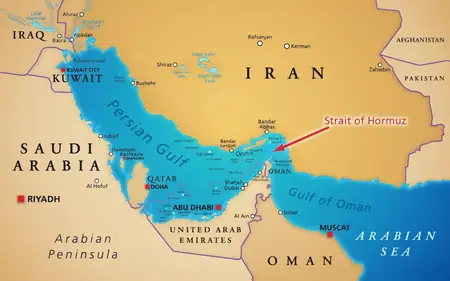
Explosive escalation grips West Asia as U.S.-Israel bombardments on Iran provoke drone-missile reprisals on Israel and U.S. outposts in Bahrain, Kuwait, Qatar. Eyes worldwide fix on the Strait of Hormuz, the congested artery where energy shipments have stalled amid threats.
Spanning Iran and Oman, this vital link from Persian Gulf to Arabian Sea narrows to 33 km, tanker lanes to 3 km apiece. An international thoroughfare bordering UAE hubs like Dubai, it’s primed for tension.
Post-strikes, Iran’s directives have deterred inbound tankers; outbound ones flee. A hit on an Oman-coast tanker—US-sanctioned—adds fog to the fray, alarming markets.
From antiquity’s silk and spice trades to today’s supremacy, the strait conveys Saudi, Iran, Iraq, Kuwait, Qatar, Bahrain, UAE oil/LNG cargoes, destined mostly for Asian powerhouses like China.
It handles 20%+ of global oil (20M+ barrels/day) and Qatar’s full LNG bounty. Sparse pipeline detours for Gulf giants leave it irreplaceable.
Interruptions portend oil/gas price spikes, petrol hikes, and inflation waves hitting Asia hardest. Flashback: 1973 oil ban, Iran-Iraq ‘Tanker War,’ 2012 shutdown bluster, 2019 UAE attacks, vessel grabs.
U.S. Fifth Fleet from Bahrain minds the lanes, but combat nullifies safeguards. Short-term blockade? Surging premiums, shortages, Asia’s agony.
With Iran clashing America-Israel, this narrow neck pulses as economy’s core—its fate sways fortunes everywhere.