
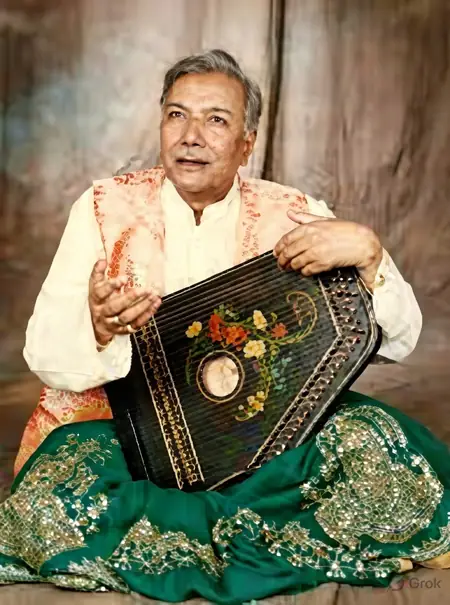
Imagine an eight-year-old boy, standing tall on stage during Janmashtami celebrations, unleashing a raga that silences a garden full of spectators. That boy was Ustad Ghulam Mustafa Khan, whose debut in Badaun’s Victoria Garden launched one of Indian classical music’s most revered careers. Born March 3, 1931, in Uttar Pradesh, his journey from child prodigy to Padma Vibhushan recipient is the stuff of legend.
Music ran deep in his veins. Father Ustad Waris Hussain Khan, surrounded by a family of artists, turned their home into a riyaz academy. From infancy, Mustafa absorbed the nuances of swaras and taans.
The municipal chairman spotted his potential at that fateful Janmashtami event. Young Mustafa performed with poise beyond his years, earning instant acclaim. ‘This child is destined for greatness,’ spectators murmured. That single night scripted his future.
He dabbled in playback singing for movies like Shree Man Ashique and Aagman, but shastriya sangeet was his soul. Notably, he shaped the voices of legends including Manna Dey, Sonu Nigam, and A.R. Rahman.
Accolades defined his later years: Padma Shri in 1991, Sangeet Natak Akademi Fellowship in 2003, Padma Bhushan in 2006, and the nation’s second-highest honor, Padma Vibhushan, in 2018. A debilitating stroke marked his final chapter, leading to his death on January 17, 2021, at 89 in Mumbai. His legacy, however, sings on eternally.