
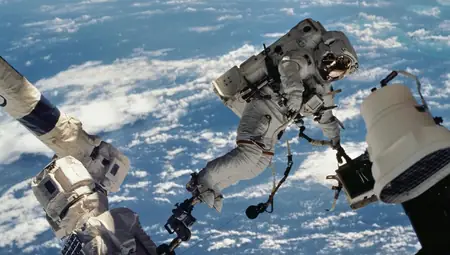
NASA’s half-century quest via its Human Research Program reveals space as a brutal testing ground for human physiology. Findings drive innovations in astronaut safety, habitat design, exercise routines, diets, and stress management. With horizons expanding to the Moon and beyond via Artemis, decoding extended space exposure is non-negotiable.
Artemis prioritizes healthy crews gathering troves of data, zeroing in on marathon mission impacts. Year-long ISS sojourns by Scott Kelly and Christina Koch doubled norms, unlocking precious physiological and mental health metrics for future use.
‘RIDGE’ sums up the core perils: Space Radiation, Isolation and Confinement, Distance from Earth, altered Gravity Fields, and Hostile/Closed Environments. Radiation leads as the prime menace; Earth’s shields block it here, but not up there.
Three culprits assail spacefarers: Earth’s trapped particles, solar particle events, and galactic cosmic rays—defenses against which remain elusive. Long-term hits raise cancer, cardiac, and degenerative disease rates, with space radiation proving fiercer in biological assays than Earth’s.
Extended lunar or Martian voyages crush ISS timelines, surging total radiation loads and threats. NASA’s arsenal: sophisticated detectors, shielding upgrades, continuous surveillance, and adaptive ops tactics. Distinctions between six-month stints and deep-space marathons inform precise countermeasures.
By confronting RIDGE head-on, NASA paves a safer interstellar highway, blending resilience with revelation.