
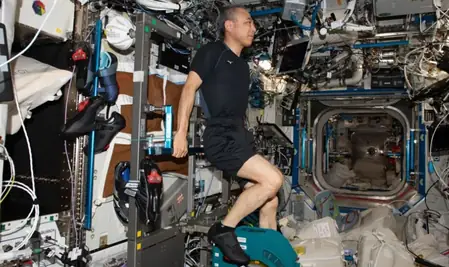
Microgravity turns the human body into a battleground. Astronauts on the ISS lose bone mass at 1% monthly and watch muscles wither without countermeasures. Earth’s gravitational pull naturally stresses skeletons and fibers through daily movement; space offers none. To avert ‘space osteoporosis,’ they exercise two hours every day with NASA-engineered marvels.
At the forefront is ARED, a 2008 powerhouse using flywheels for up to 600 pounds of resistance, enabling deadlifts, bench presses, and squats that fool the body into building strength. T2’s treadmill harnesses users firmly, simulating pounding pavements for cardiovascular and lower-body gains.
The CEVIS cycle, vibration-isolated since 2001 and upgraded recently, delivers data-driven rides monitoring heart rates and power outputs. Evolving from elastic bands to these high-tech aids, protocols now favor intense, brief sessions over prolonged efforts—studies show superior muscle and bone retention, plus VO2 max stability vital for endurance.
Biopsies illuminate cellular defenses activated by training, though variability among astronauts highlights personalization needs. Amid tight confines, gear fixes, and thermal-humidity woes, these routines prove indispensable. Looking ahead, refined regimens will armor explorers for multi-year treks, securing the future of human spaceflight.