
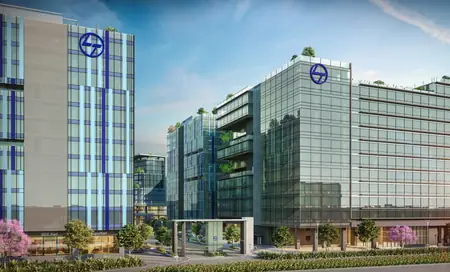
The specter of Middle East conflict has unleashed chaos on Dalal Street, with L&T’s market capitalization cratering by ₹45,629.03 crore to ₹5,43,208.36 crore. As one of India’s premier firms, L&T’s plight signals broader risks for companies tied to the region.
With substantial operations in the Middle East, L&T faces potential project halts and cost overruns amid rising hostilities. Market watchers say this exposure turned a regional flare-up into a domestic market rout.
The damage spread wide: Eight of the top 10 companies hemorrhaged ₹2,81,581.53 crore combined. SBI saw the steepest fall, down ₹53,952.96 crore to ₹10,55,567.27 crore. ICICI Bank’s value eroded ₹46,936.82 crore to ₹9,40,049.82 crore, while HDFC Bank lost ₹46,552.3 crore, settling at ₹13,19,107.08 crore.
Bajaj Finance dropped ₹28,934.56 crore to ₹5,91,136.03 crore. TCS shed ₹28,492.44 crore to ₹9,25,380.15 crore. HUL’s market cap fell ₹26,350.67 crore to ₹5,23,042.51 crore, and Bharti Airtel declined ₹4,732.75 crore to ₹10,67,120.50 crore.
Bright spots included Reliance Industries, up ₹14,750.39 crore to a towering ₹19,01,583.05 crore, and Infosys, which gained ₹3,459.99 crore to ₹5,30,546.54 crore.
Religare Broking’s Ajit Mishra explained: ‘Geopolitical heat in West Asia, coupled with crude oil spikes, soured sentiment in a truncated trading week.’ The result? A bruising close that has investors rethinking strategies.
This market jolt serves as a wake-up call. As tensions simmer, Indian corporates with overseas bets must navigate uncharted waters, balancing growth ambitions against geopolitical wildcards.