
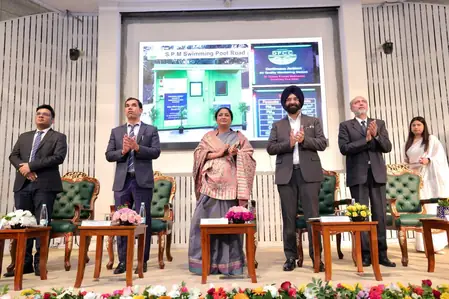
Delhi’s relentless fight against air pollution gained high-tech muscle today with the launch of six Continuous Ambient Air Quality Monitoring Systems by Chief Minister Rekha Gupta. Complementing this, the ‘Vayu Rakshak’ fleet of 35 EVs was set in motion, backed by 100 enforcers to deliver real-time vigilance and rapid response.
Environment Minister Manjinder Singh Sirsa, who oversaw the event, posted enthusiastically: these systems will nail down PM2.5 and PM10 readings, while the fleet serves as the city’s ‘ground force’ for live checks and rule enforcement.
Now totaling 46, the monitoring grid spans urban sprawl, offering granular insights into air dynamics. This data goldmine will expose culprits like stubble burning echoes or factory fumes, enabling preemptive strikes.
New sites encompass academic hubs like JNU and IGNOU, tech campus NSUT West, and public spaces at Akshardham CWG, Delhi Cantt CWG, and Talkatora Garden. ‘We’re not just talking problems; we’re solving them on the ground,’ Sirsa asserted.
The mobile Vayu Rakshak units fill critical voids in static monitoring, ensuring no corner escapes scrutiny. Amid rising respiratory cases, this dual approach—tech plus patrols—could slash AQI peaks dramatically.
Stakeholders applaud the scale-up, urging synergy with NGPCR norms. With winter inversions approaching, these tools position Delhi for smarter, science-driven pollution control, fostering hope for sustainable urban air.