
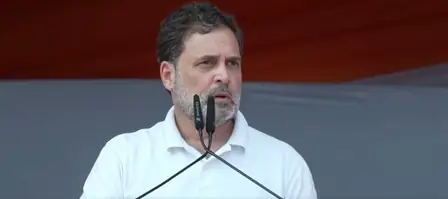
Rahul Gandhi turned up the heat on the Narendra Modi administration during his address at Bhopal’s high-profile ‘Kisan Maha Chaupal.’ The gathering, a direct response to the India-US trade pact, featured Congress President Mallikarjun Kharge and drew thousands of farmers and party workers.
Parliament gagged him, Gandhi charged, when he sought to deliberate on excerpts from ex-Army Chief MM Naravane’s memoir. It describes Chinese tanks rolling towards Indian lines, with Naravane dialing Defence Minister Rajnath Singh for authorization. The line stayed unclear.
Efforts to consult NSA Ajit Doval and EAM S Jaishankar drew blanks. Two hours on, a follow-up with Singh pointed to the PMO, delivering the non-committal green light: ‘Proceed as suitable.’ The government, per Gandhi, deserted its soldiers in the hour of need.
He decried the suppression of opposition voice after the President’s address, a break from longstanding parliamentary etiquette that erodes institutional integrity.
Shifting focus, Gandhi mourned the February 22 Gorakhpur outrage against a female doctor from Nagaland—pursued, verbally abused, and reportedly violated. This tragedy, he said, mirrors deepening societal hatred and peril for women from India’s Northeast.
To the Youth Congress, he roared: You’re ‘Babbar Sher’—untamed lions who fear no one. Applause thundered, reinforcing Gandhi’s role as a vocal critic in India’s polarized political arena.