
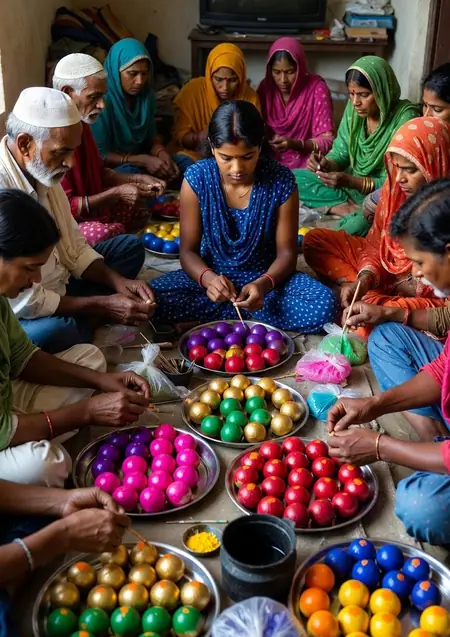
Holi in Jaipur isn’t your standard color frenzy. At its heart is ‘Gulal Gote,’ fragile lac balls filled with scented powder, representing a profound inter-community alliance that dates to the city’s birth. Muslim artisans from the Manihar community craft these for a Hindu festival, epitomizing communal harmony.
Each Gote is a marvel of delicacy: 4-6 grams of lac hollowed into a thin shell, packed with eco-safe gulal that bursts harmlessly on contact. It’s color play perfected, blending fun with finesse.
Established alongside Jaipur in 1727 by Sawai Jai Singh II, this craft thrives in ‘Maniharon ka Rasta.’ Generations of Muslim families have passed down the torch, their 21st-century heirs balancing tradition with innovation amid modern challenges.
Step-by-step, the process unfolds: molten lac shaped by controlled breaths into orbs, stuffed with fragrant powders, and meticulously sealed. The artisan’s focus is absolute; failure means starting over.
From opulent royal Holi parades to today’s palace events, Gulal Gote remain indispensable. Their natural composition ensures no pollution or health risks, aligning with global calls for green festivals.
Jaipur’s Holi whispers a larger narrative: in diversity lies strength. These colorful orbs are more than playthings – they’re bridges of trust, colored by shared history and mutual respect.