
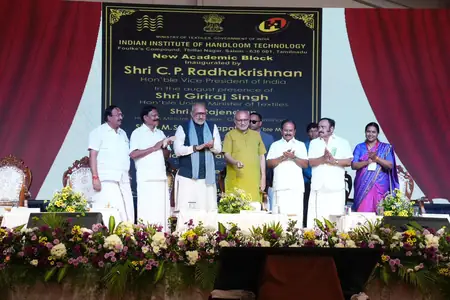
Vice President C.P. Radhakrishnan’s visit to Salem culminated in the inauguration of IIHT’s new academic facility, a beacon for handloom modernization. He lauded the institute for seamlessly merging traditional skills with innovative science, readying weaves for international acclaim.
The event evoked Salem’s legacy, tied inextricably to C. Rajagopalachari, whose journey from local lawyer to national icon began here. Referencing the fresh bust at Rashtrapati Bhavan, the VP connected past glories to present ambitions.
IIHT’s mission? Elevate productivity and quality in handlooms, adapting to market needs while safeguarding authenticity. Examples abounded: Varanasi silks, Bengal Jamdanis, Assam Muga, Kashmiri Kani, Andhra’s Venkatagiri and Mangalagiri cottons, MP’s Maheshwari and Chanderi masterpieces.
Local pride took center stage with Tamil Nadu specials—Kandangi saris from Chettinad, famed Kanchipuram silks, Arani, Thirubuvanam silks, Chenimalai woolens, Nagercoil veshtis, Madurai Sungudis. These crafts fuel cultural and economic vitality.
The India-EU FTA emerged as a game-changer, amplifying competitiveness thanks to PM Modi’s strategic drive. Expect booming exports from Salem textiles and Ambur leathers to Europe. IIHT must lead the charge, evolving handlooms into value-driven industries that dignify artisans and guarantee sustainable livelihoods.
An impressive exhibition of national handlooms drew crowds, with Union Minister Giriraj Singh and Tamil Nadu’s R. Rajendran in attendance. This initiative fortifies heritage, infuses technology, and brightens prospects for countless weaving families across India.