
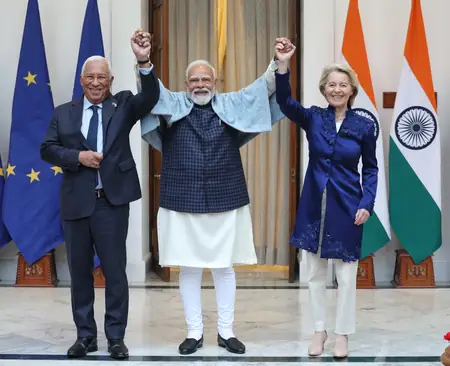
Prime Minister Narendra Modi hosted European Council President Antonio Costa and European Commission President Ursula von der Leyen in New Delhi for the landmark 16th India-EU Summit, coinciding with Republic Day festivities. The leaders renewed vows to advance their strategic alliance on pillars of democracy, human rights, pluralism, legal governance, and a UN-centric international framework.
Key focuses included joint security responses, sustainable development, economic fortitude, climate action, biodiversity protection, and SDG momentum— all encapsulated in a detailed joint declaration post marathon talks.
As Republic Day chief guests, the EU duo brought a powerhouse team featuring High Representative Kaja Kallas and Trade Commissioner Maros Sefcovic.
Cheers erupted for the inaugural India-EU Security and Defence Partnership, a robust blueprint deepening engagements across maritime security, industry-tech exchanges, cyber-hybrid defenses, space, and counter-terrorism. An Information Security Agreement talks launch promises seamless classified exchanges, elevating defence cooperation.
They championed UN-led multilateralism, demanding Security Council reforms for representativeness and efficacy amid shifting geopolitics. Linking European and Indo-Pacific destinies, they endorsed a UNCLOS-compliant vision, hailing new consultations and frameworks like IPOI and IORA.
Ukraine conflict’s humanitarian crisis and global fallout prompted support for Charter-aligned peace processes. Middle East woes, including Iran, necessitate dialogue. Gaza saw endorsement of Resolution 2803 for stabilization, aid imperatives, and two-state peace.
Terror’s every shade—cross-border included—met fierce denunciation, spotlighting Pahalgam (22 April 2025) and Red Fort (10 November 2025) atrocities. Calls rang for unified international crackdowns on extremism, finances, laundering, tech misuse, and recruitment.
The summit’s outcomes signal a fortified India-EU axis, ready to navigate and influence global challenges with resolve.