
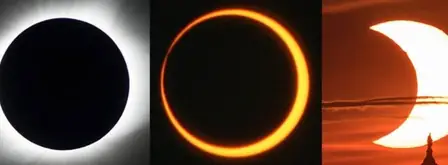
The celestial calendar flips to 2026 with an exciting opener: February 17’s annular solar eclipse, famously called the ‘Ring of Fire.’ This phenomenon will grace Antarctica’s remote icy landscapes, peaking with a luminous solar ring lasting roughly 2 minutes and 20 seconds.
Solar eclipses happen during precise alignments of the Sun, Moon, and Earth. The Moon’s shadow sweeps across our planet, briefly eclipsing sunlight. Occurring in biannual seasons, they’re governed by orbital inclinations that rarely sync perfectly.
During annuluses, a distant Moon fails to cover the Sun fully, crafting a vivid ‘fire ring’ effect. Indian viewers will miss it, but simulations and reports will abound.
Delve deeper into eclipse varieties. Total solar eclipses create surreal midday nightfall, unveiling the Sun’s corona in ethereal glow – the holy grail for eclipse chasers.
Annulars deliver their iconic ring, partials show a crescent Sun as if partially devoured, and hybrids morph from total to annular mid-path due to geometric quirks on Earth’s curved surface.
These events aren’t just visual feasts; they aid scientific study of the Sun’s atmosphere and test relativity theories. Historically, they’ve influenced cultures, calendars, and myths worldwide.
With climate change altering viewing spots, preservation of dark skies grows vital. Equip yourself with ISO-compliant glasses for safe observation. As 2026 unfolds, more eclipses loom, promising continued awe and discovery in the heavens above.