
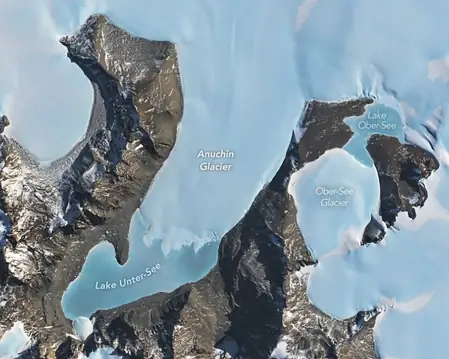
Antarctica harbors mysteries beneath its vast ice sheets, none more intriguing than Unter-See Lake in the Gruber Mountains of Queen Maud Land. Perched near the Anuchin Glacier’s terminus, this sub-ice reservoir stays locked under thick ice, battling temperatures averaging minus 10°C. On February 16, 2026, NASA’s OLI sensor aboard Landsat 9 captured its ethereal summer visage—ice-clad waters amid a frozen wilderness.
Seasonal glacier thaw sustains the lake, with sunlight’s faint rays offering scant warmth below the surface. Relentless winds hasten sublimation, preserving the icy barrier. Boasting 558 feet of depth, its chemistry is exceptional: abundant oxygen, minimal CO2, and alkaline richness support rare ecosystems.
The stars here are enormous conical stromatolites, built by light-harnessing cyanobacteria that cement sediments into rising calcium carbonate towers, exhaling oxygen. In 2011, Dale Andersen’s SETI team revealed these half-meter behemoths, far surpassing the tiny versions in Lake Joyce. Ideal conditions—wave protection, pristine water, low turbidity, dim light—enable their grandeur.
Hardy tardigrades reign as the biggest creatures, thriving where others perish. Evoking 3-billion-year-old microbial dominance, these forms parallel ancient fossils from Greenland and Western Australia. They serve as Earth-based proxies for Europa’s, Enceladus’s, and Martian ice-bound habitats in astrobiology research.
Yet, drama unfolds beneath the calm. Ottawa University’s 2019 expeditions, backed by NASA’s ICESat-2 data, traced 17.5 million cubic meters from Ober-See’s sudden flood. pH swings, CO2 surges fueled microbial surges, but researchers highlight risks: such events could unravel Antarctic ecologies, signaling broader climate threats.