
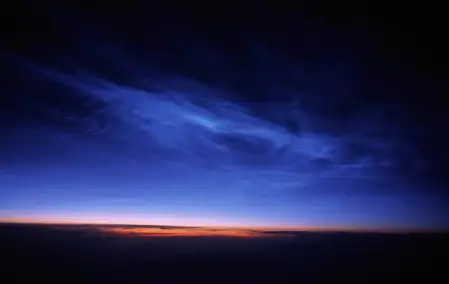
Deep in the twilight zone between day and night, noctilucent clouds unfurl like cosmic veils, glowing mysteriously against the black sky. These high-altitude marvels, perched in the mesosphere at 50-86 kilometers, defy everyday weather patterns by reflecting sunlight hours after dusk.
Composed of ice crystals no larger than smoke particles, they thrive in temperatures dipping to -130°C. Sunlight scatters off these prisms, producing electric blues, silvers, and occasional purples—colors that pop vividly when lower skies darken. Primarily a summer phenomenon near the poles, they’ve tantalized skywatchers and scientists alike.
The AIM satellite’s 2007 debut marked a breakthrough, mapping these clouds’ full lifecycle from formation in late May to dissipation in late August. It exposed their ubiquity: sprawling covers that morph constantly, revealing a stable ice sheet at extreme heights.
Intriguingly, their frequency and brilliance have surged. No longer confined to Arctic and Antarctic summers, sightings creep equatorward. Culprits include rising tropospheric methane oxidizing into mesospheric water vapor, amplifying crystal formation. This evolution hints at profound atmospheric responses to human-induced changes.
As tools like AIM evolve, noctilucent clouds emerge as sentinels of climate health. Their increasing visibility calls for vigilance, transforming a poetic sky show into a harbinger of environmental flux.