
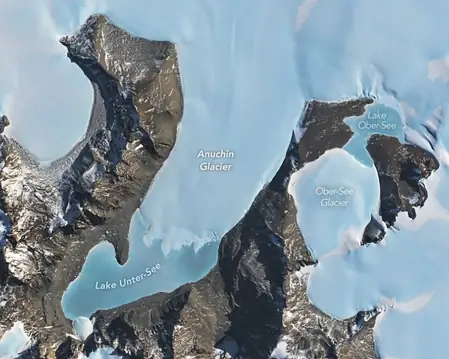
Antarctica’s Unter-See Lake stands as a time capsule under ice, located at the Anuchin Glacier’s terminus near Queen Maud Land’s Gruber Mountains. Locked year-round under thick ice in sub-zero temperatures averaging minus 10°C, it challenges our understanding of life’s limits.
NASA’s February 16, 2026, Landsat 9 image illuminates this enigma during brief summer warmth, depicting ice-clad waters and icy surrounds. Glacier melt supplies most inflow, with sunlight’s faint penetration warming depths, though winds drive rapid sublimation.
At 558 feet maximum depth, the lake’s chemistry—oxygen-saturated, CO2-poor, alkaline—nurtures colossal stromatolites. Photosynthetic cyanobacteria engineer these cone-shaped behemoths, trapping particles in mucilaginous mats to build crusty, oxygen-exhaling towers.
In 2011, Dale Andersen’s SETI team revealed these 50 cm-high wonders, giants compared to Lake Joyce’s miniatures. Their stature stems from ice-shielded calm, crystal waters, low turbidity, and dim light—perfect for unchecked expansion.
Hardy tardigrades rule as top predators here. These formations recapture Earth’s microbial dawn 3 billion years back, matching ancient fossils in Greenland and Western Australia. Astrobiology sees parallels to subsurface oceans on Europa, Enceladus, and Martian relics.
Dramatic shifts punctuate tranquility. ICESat-2 data from 2019 tracks a massive influx: 17.5 million cubic meters from Ober-See’s breach, confirmed by Ottawa University fieldwork. Chemistry flipped—higher CO2, pH swing—fueling microbial surges. Scientists caution these outburst floods imperil Antarctic biodiversity, foreshadowing climate upheaval in frozen frontiers.