
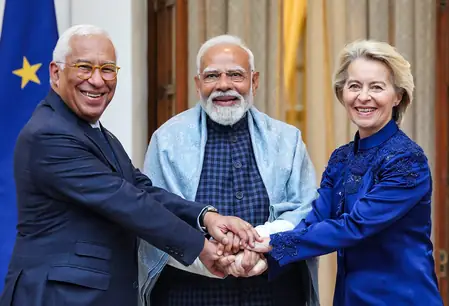
Global markets buzz with the India-EU Free Trade Agreement, the so-called ‘Mother of All Deals,’ signaling a profound reconfiguration of international trade amid escalating geopolitical strains, tariff walls, and weakening global governance.
The agreement, proclaimed by top leaders Ursula von der Leyen, Antonio Costa, and PM Narendra Modi, bridges economies encompassing 2 billion consumers and 25% of global GDP, poised to unlock vast opportunities.
Ravinder Kaur, Asian Studies professor at Copenhagen University, analyzes this as evidence of deepening ties in institution-building, security cooperation, R&D, human mobility, and connectivity, notably in the Indo-Pacific theater.
With the US focusing domestically, the Indo-Pacific welcomes EU partnerships, Kaur writes, framing the FTA as a cornerstone of an emerging ‘post-US world.’
This fits a pattern: EU’s Mercosur accord, India’s recent UK and New Zealand FTAs, and others brewing. Challenges in execution notwithstanding, they herald a rush toward multipolarity, strategic independence, and lessened reliance on the dollar—long-held aspirations of the Global South gaining speed.
A South Asia specialist at New York’s Asia Society believes the EU pact nudged the US to accelerate its protracted trade talks with India. Farwa Ameer notes the intriguing timing, injecting new vigor into bilateral discussions.